The Volunteers
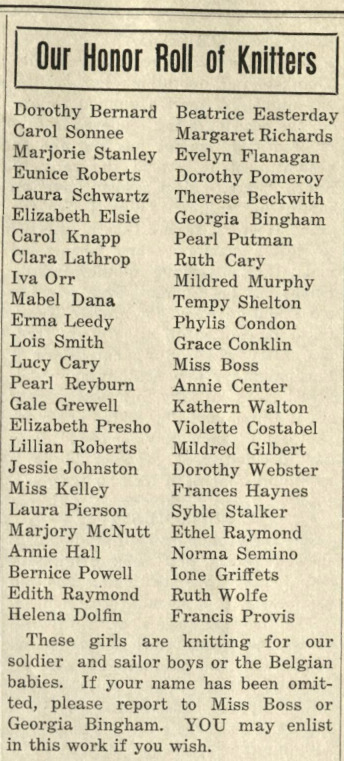
While the first thing that springs to mind when talking about volunteering during WWI is volunteering for the armed forces, Pacific students also were engaged in other work as well. Female students are recorded in issues of The Pacific Weekly as joining the Red Cross to be trained to become nurses and participating in sewing and knitting clubs to make clothes for soldiers. Interestingly, though, in later issues, the knitting club is referred to as a "co-ed knitter's club."
Male students also had some volunteer opportunities, albeit more limited due to the need for soldiers which led to the Selective Service Act of 1917 and the drafting of many young men into the armed forces. Male students could join the YMCA, with three students listed as members in the February 27, 1918 issue of The Pacific Weekly. The disparity between the number of male students volunteering in the YMCA and those in the military is especially evident as Pacific’s “Service Flag,” unveiled in Pacific’s chapel on February 22nd dedicated to both enlisted students and alumni, had “one hundred and two either in the army or navy, and three in Y. M. C. A. work.” Notably, a popular Pacific faculty member, William Stidger, initially volunteered as a YMCA clerk, however later, in the December 12th, 1917 issue of The Pacific Weekly, it is recorded that “he thinks that he can do more good in France among the army camps for which he expects to sail in the near future.”
Pacific’s knitting clubs would be mentioned in multiple Pacific Weekly issues, with a list of “Our Honor Roll of Knitters,” appearing to comprise mainly women, being printed in the November 27th, 1917 mirroring “Our Honor Roll” that was printed for enlisted men in other issues, first appearing in the October 4th, 1917 issue. Notably, the wife of President Seaton was among these women, as well as Georgia Bingham, who appears to be a relative of enlisted student Jenness Bingham. Later issues in December of 1917 began to list more than only the names of Pacific’s knitters and included a list of what each person was working on and already completed projects. The December 19th, 1917 issue records:
“Totals: Finished garments—Sweaters, 21; Scarfs, 13; Socks, 6 prs.;
Wristlets, 4 prs.; Trench Cap, 1. Total made articles, 55.
In the making—24 Sweaters, 14 Scarfs, 3 prs. Socks, 2 prs. Wristlets,
1 Helmet, 1 Trench Cap. Total making, 50.”
Both men and women had the choice to join the YMCA, The Salvation Army, and other organizations. The YMCA notably conducted relief work during the war, delivering food to soldiers and civilians alike, and conducting roughly “90% of all welfare work with the American Expeditionary Forces [the name given to the American armies sent to France] in Europe” according to “The History of The YMCA in WWI” on WorldWar1.com. Furthermore, according to that same article, citing YMCA records, roughly 26,000 men and women worked as paid staff while roughly 35,000 worked as volunteers during the war.
The Servicemen
While before a wartime draft was introduced in April of 1917 some Pacific students had already enlisted, most men would enter the armed forces as draftees. As mentioned earlier, as of 1918, roughly 102 Pacific Students and Alumni would be enlisted in the military. The locations of some of these men can be tracked using their appearances in issues of The Pacific Weekly. I have assembled a map showcasing the locations of some of these men, and while their exact journeys can be hard to trace in some respects, this map seeks to provide a broad overview of where exactly Pacific's enlisted students would end up during the war.