Pacific's Response

The Early Response
There is no doubt that soon after the declaration of war on Germany on April 6th, 1917, many Pacific students felt a strong desire to involve themselves in the war effort, whether that be male students looking to enlist in the military or female students joining organizations such as the Red Cross to be trained to become nurses.
Despite this enthusiasm, shortly after war was declared on April 6th, Pacific students were urged to not enlist and instead were encouraged to continue to devote themselves to college until a call for men was issued.
An April 11th, 1917 issue of The Pacific Weekly quotes Major-General Leonard Wood, then the head of the Army’s Southern Department and in command of several military bases in Texas, New Mexico, and Oklahoma, as advising students, “to stick to their present duties until such time as the Government calls for men. There is no reason whatever for the men discontinuing their college work until the Government plans are definitely announced.”
Major-General James Bell is also quoted in this issue as well with a similar outlook. Bell commanded the Army’s Western Department as of 1917 and, like Wood in the southern Midwest, was in overall command of numerous Army bases across the West Coast in California, Oregon, and Washington.
Bell’s letter to the president of the University of California advises that “I think it highly important that your portion of your student body available for military duty should be held as nearlyintact as possible until the plans of the war department, now in process of formulation, are completed and published.”
That same issue of The Pacific Weekly also recounts how Pacific’s President John L. Seaton, who had recently returned from a trip to Hawaii, had begun investigating student enlistment and consulting the President of Stanford Ray L. Wilbur on the matter.
The Students Call For Action
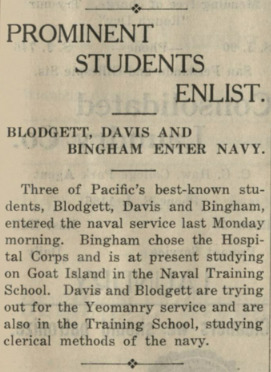
Whether the administration wanted them to or not, students from Pacific began to enlist in the military. Three students are reported as enlisting in the Navy in the April 18th issue of The Pacific Weekly, those students being Jenness Bingham, H. Carlton Blodgett, and Frank Davis. These three men would be the first of many to enlist or be drafted in the coming months.
In addition, in the face of a lack of any way to prepare students for military service, students began to organize their own solutions to prepare themselves. The Pacific Weekly’s April 18th, 1917 issue reports that “a number of students have started a movement which seems to answer the need [for a training program]. A man has been secured to act as drillmaster, who was formerly an officer in the U. S. service. He has offered his services for three afternoons each week and arrangements are being made to secure the loan of modern rifles for drill purposes.”
This drill program, taught by R. L. Walker, a former Army officer with seven years of service, consisted of only rifle drill, however, students report that it allowed them to go through basic training far easier than those who had not had that instruction.
A Formal Program
By November 14th, 1917, the student-born drill program had been in place for roughly four months. This would soon change, however, as by that point a formal system of integrating military drill and instruction and student life was introduced by President Seaton and Captain Walker, the officer placed in charge of the drill program.
This was part of a nationwide program known as the “Student Army Training Corps” where according to Pacific on The Rise, “colleges were run as full-time army training camps. By fall 1918, 140,000 men were inducted into the United States Army at 525 colleges, including over 100 at Pacific, though about one-fourth of these were already regular students of the College.”
Furthermore, according to Pacific On The Rise, while this program brought much-needed money to Pacific’s coffers, it also brought chaos to the campus, with the school being required to admit any applicants until their enrollment limit was met leading to many students being admitted that ended up not graduating due to not being prepared for the strain of campus life.
“The commanding officer was certainly no academic dean. Schoolwork sagged. Dormitory disruptions and destructions were common. Football was suspended in favor of military drills for 60 men.”